
How to Plan a Virtual Burial at Sea for Remote Family Members?


- access_timeMay 8, 2026
- account_circleGary Jackson
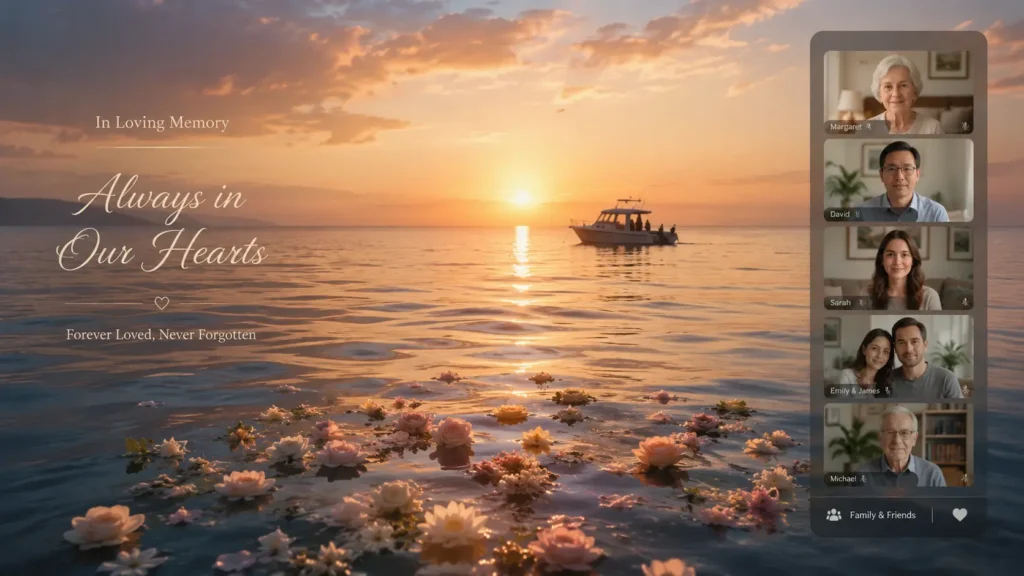
Virtual burial at sea ceremony with remote family members attending online
A burial at sea is already a deeply meaningful way to say goodbye. For many families, the ocean represents peace, eternity, freedom, and return. But modern families are often spread across different cities, states, and countries. Some loved ones may be elderly, ill, unable to travel, or too far away to attend in person. A virtual burial at sea allows remote family members to participate in the ceremony, witness the farewell, and feel emotionally included even when they cannot physically be on the boat.
Families planning a sea memorial may choose an attended service, an unattended service, scattering ashes at sea, or a full-body burial at sea. BurialAtSea.com offers information about both scattering ashes at sea and full-body burial at sea, with service options in Southern California, including San Pedro, Long Beach, and Catalina Island. BurialAtSea.com also notes that scattering ashes is one of the most common sea burial practices and may include an urn, flowers, petals, and wreaths as part of the ceremony.
What Is a Virtual Burial at Sea?
A virtual burial at sea is a memorial ceremony performed on the ocean while family members and friends attend remotely through a private video call or livestream. The ceremony may include the scattering of cremated remains, the release of a biodegradable urn, readings, prayers, music, personal tributes, or a quiet moment of reflection.
The purpose is not to turn the ceremony into a production. The purpose is to create a respectful, intimate, and emotionally complete experience for everyone involved. With proper planning, remote family members can hear the words being spoken, see the ocean, share memories, and witness the moment of farewell.

Remote family members joining a virtual burial at sea from home.
Step 1: Decide Whether the Ceremony Will Be Attended, Unattended, or Hybrid
The first decision is whether family members will attend in person, join remotely, or combine both options. A hybrid burial at sea allows a small group to be present on the boat while other family members join virtually. This is often the best option when only a few relatives can travel.
An unattended sea scattering may also be appropriate when the family cannot attend physically. BurialAtSea.com explains that unattended sea scattering is often chosen when family members cannot be present due to distance, illness, or other limitations. Families may still create a meaningful virtual memorial around the event by having the provider document the ceremony, share GPS coordinates, and provide photos or video afterward.
For families still learning how the process works, a helpful internal resource is:
How Does Burial at Sea Work?
Step 2: Understand the Legal Requirements
In the United States, burial at sea is regulated by the Environmental Protection Agency under the Marine Protection, Research, and Sanctuaries Act. The EPA general permit authorizes the burial of both cremated and non-cremated human remains in ocean waters under specific conditions. (US EPA)
For cremated remains, the burial must take place at least three nautical miles from land. The EPA also requires that the burial be reported within 30 days after the event. The EPA states that no application or prior notice is required before the burial under the general permit, but post-event notification is required.
Families should also avoid placing anything in the water that is not readily decomposable. The EPA specifically states that plastic flowers, synthetic wreaths, metal items, monuments, artificial reefs, and similar non-decomposable materials are not allowed under the general permit.
Step 3: Choose the Right Burial-at-Sea Provider
A virtual burial at sea requires more coordination than a standard ash scattering ceremony. The provider should understand ocean burial logistics, ceremony flow, EPA reporting requirements, vessel safety, and the emotional needs of grieving families.
When choosing a provider, families should ask whether the company can support a virtual ceremony, whether the boat has reliable cellular reception offshore, whether photos or video can be provided, and whether the captain can document the GPS location. BurialAtSea.com describes service areas including San Pedro, Los Angeles, Long Beach, and Redondo Beach, giving families several Southern California options for a sea memorial.
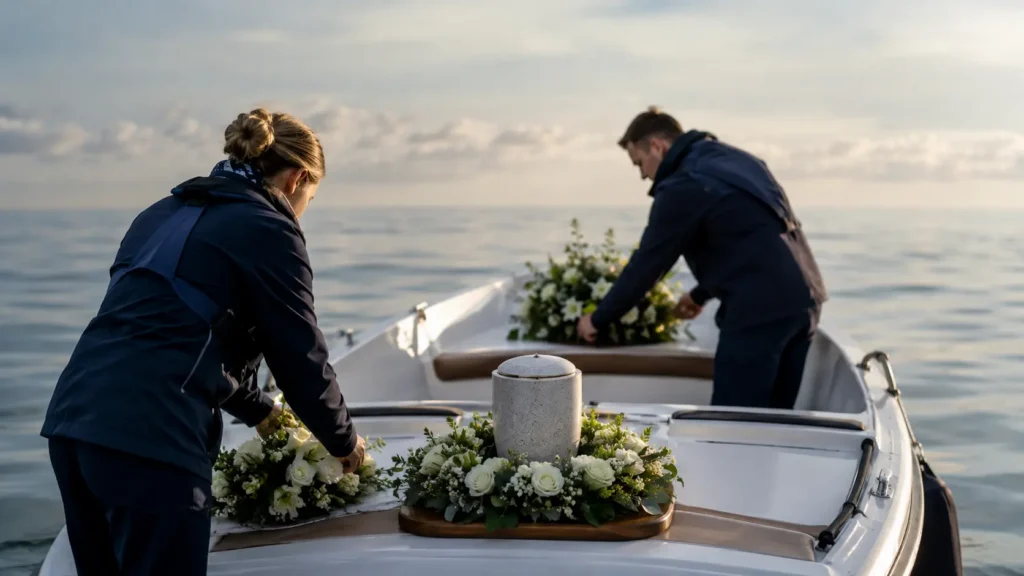
Burial at sea provider preparing a boat for an ocean memorial ceremony.
Step 4: Select the Best Virtual Platform
The best virtual platform depends on the family’s comfort level. Zoom is usually a strong choice for larger families because it allows muting, recording, screen management, and multiple speakers. FaceTime may be easier for smaller family groups. Google Meet can also work well, especially for families already using Gmail.
The most important rule is simplicity. Remote attendees should receive one clear link, one ceremony time, and simple instructions. For elderly family members, it is helpful to schedule a short test call before the ceremony. This prevents confusion and allows everyone to feel comfortable before the emotional moment begins.
Step 5: Assign a Virtual Ceremony Coordinator
One person should be responsible for managing the virtual portion of the service. This person can start the call, admit guests, mute background noise, help relatives speak at the right time, and record the ceremony if the family wants a private copy.
The coordinator should not be the closest grieving family member if avoidable. A friend, extended relative, or staff member can often manage this role more calmly. Ideally, one person should manage the livestream from land, while another person on board handles the camera or phone.
Step 6: Prepare the Ceremony Script
A virtual burial at sea ceremony should be simple, organized, and emotionally meaningful. It does not need to be long. A 15- to 25-minute service is often enough.
A respectful ceremony may include a welcome, a short reflection, a poem or prayer, brief family memories, the scattering or release of the remains, a moment of silence, and closing words. Remote family members can participate by reading a poem, sharing a memory, or submitting written tributes in advance.
Step 7: Use a Biodegradable Urn When Appropriate
If the family plans to place cremated remains into the ocean inside an urn, the urn should be appropriate for water burial. BurialAtSea.com explains that biodegradable cremation urns are often used for scattering ashes or placing a dissolving urn into the sea, and that the right urn can shape the experience of saying goodbye.
The EPA also states that cremated remains may be buried at sea inside an acceptable container, but the container must not contain plastic, float, or contribute to marine debris. Ideally, it should dissolve or degrade in a relatively short period of time in the marine environment.
Step 8: Plan the Camera and Audio Setup
The camera should show the ocean, the speaker, and the moment of farewell without feeling intrusive. A smartphone can work well if it is stable and protected from wind and water. A tripod, phone grip, or handheld stabilizer can improve the experience.
Audio is often more difficult than video. Wind, waves, and engine noise can make it hard for remote family members to hear. If possible, use a wireless microphone with a windscreen. The person speaking should stand close to the camera and speak slowly.
Remote attendees should remain muted unless they are invited to speak. This keeps the ceremony quiet, focused, and respectful.
Step 9: Include Remote Family Members in a Meaningful Way
Remote family members should not feel like spectators. They can participate by lighting a candle at home, holding a photograph, reading a poem, wearing a meaningful color, or sharing a short memory.
One simple idea is to ask each family member to complete this sentence before the ceremony:
“I will always remember…”
These short messages can be read aloud during the service or saved as part of a memorial keepsake.
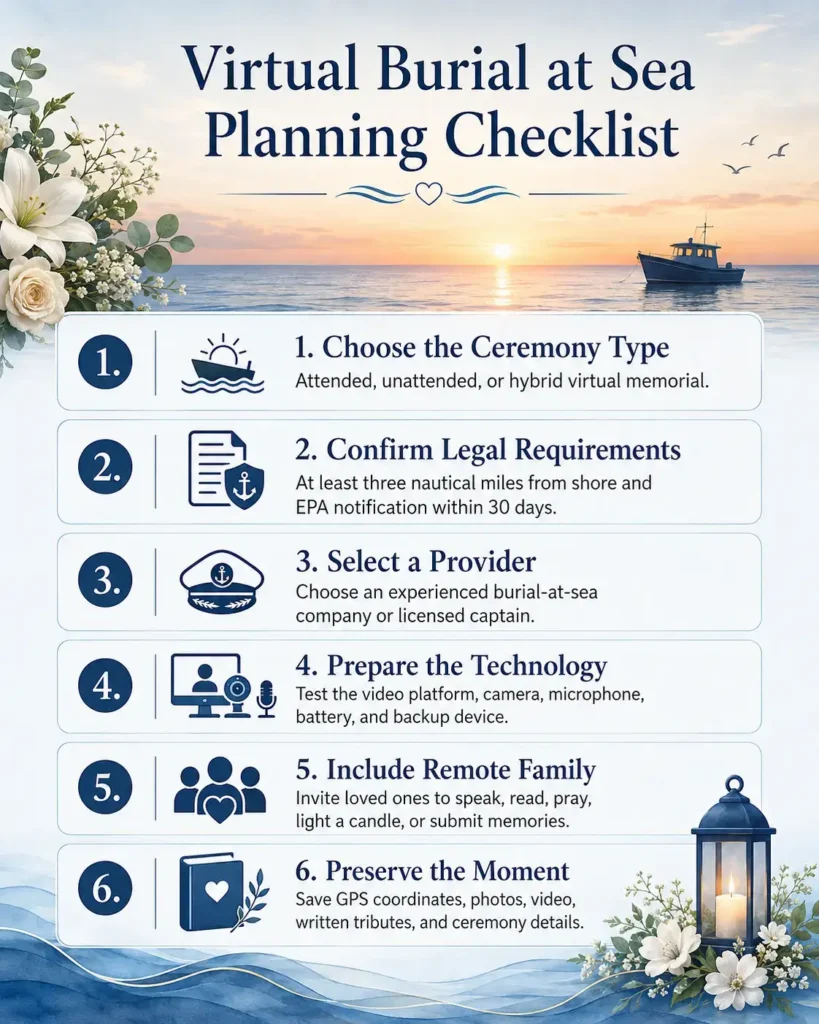
Virtual burial at sea planning checklist for families arranging an online ocean memorial.
Step 10: Decide Whether to Record the Ceremony
Recording can be helpful for relatives who cannot attend live because of distance, illness, work, or time-zone differences. However, the recording should be discussed in advance. Some families may want a private video, while others may prefer the ceremony to remain live only.
If the ceremony is recorded, the file should be shared privately with approved family members. Avoid posting the full service publicly unless the immediate family agrees.
Step 11: Prepare a Backup Plan
Ocean ceremonies depend on weather, marine conditions, vessel schedules, and internet connectivity. Families should prepare for the possibility of delay or rescheduling.
A backup plan may include a second phone, portable battery, extra charging cable, backup video platform, and a plan to record the ceremony if the livestream fails. If the connection becomes unstable offshore, the provider may still be able to take photos, record video, and provide GPS coordinates afterward.
Step 12: Create a Memorial Follow-Up
After the ceremony, families may want to send a private memorial email to attendees. This can include the date of the ceremony, the ocean location, GPS coordinates, selected photos, a short video clip, and written tributes from family members.
This follow-up helps remote relatives feel included even after the ceremony has ended. It also creates a lasting record of the farewell.
Sample Virtual Burial at Sea Invitation
Dear Family and Friends,
We will be honoring the life of [Name] with a burial at sea on [Date] at [Time]. Because many loved ones are unable to attend in person, we will provide a private virtual link so everyone can participate from wherever they are.
Please join the call 10 minutes early. You are welcome to have a candle, flower, photograph, or written memory with you during the service. If you would like to share a short memory, please let us know in advance so we can include you in the ceremony.
With love,
[Family Name]
Alt Text:
Flowers floating on the ocean after a virtual burial at sea ceremony.
Conclusion
A virtual burial at sea allows families to honor a loved one with dignity, even when distance makes it impossible for everyone to gather in person. With the right provider, careful ceremony planning, reliable technology, and respect for legal requirements, remote family members can still be present for a deeply meaningful farewell.
Whether the family chooses an attended ceremony, unattended scattering, or a
hybrid virtual memorial, the ocean can provide a peaceful and lasting place of remembrance. For families in Southern California, BurialAtSea.com provides helpful information about burial at sea services, scattering ashes at sea, full-body burial at sea, and biodegradable cremation urns.