
What to Do With Pet Ashes? Everything You Need to Know


- access_timeJuly 8, 2026
- account_circleGary Jackson
Losing a beloved pet can feel like losing a member of the family. Pets share our homes, routines, milestones, and memories, so it is understandable that many families want to choose a peaceful and meaningful final resting place for them.
For people who feel connected to the ocean, scattering a pet’s ashes at sea may seem like a beautiful way to say goodbye. However, federal burial-at-sea regulations treat human remains and animal remains differently.
Before arranging an ocean memorial for a pet, it is important to understand what federal law allows, what it does not authorize, and which legal alternatives may provide a similarly meaningful tribute.
Can You Legally Scatter Pet Ashes at Sea?
Under the standard federal burial-at-sea permit, pet ashes cannot be scattered in U.S. ocean waters.
The Environmental Protection Agency regulates burial at sea under the Marine Protection, Research, and Sanctuaries Act, commonly known as the MPRSA. The general permit issued under this law applies specifically to human remains, including cremated human remains and qualifying full-body burials.
The EPA states that the general permit does not authorize the placement of nonhuman remains, including the cremated remains of dogs, cats, and other pets. Pet ashes also cannot be combined with human cremated remains for an otherwise authorized burial at sea.
Therefore, families should not assume that the rules permitting human ash scattering also apply to pets.
Does the Three-Nautical-Mile Rule Make Pet Ash Scattering Legal?
No. Traveling at least three nautical miles from shore does not automatically make scattering pet ashes legal.
The three-nautical-mile requirement is one of the conditions that applies to the burial or scattering of human remains under the EPA’s general permit. Cremated human remains may be placed in ocean waters of any depth, provided the ceremony takes place no closer than three nautical miles from land. The burial must also be reported to the appropriate EPA regional office within 30 days.
These provisions do not expand the permit to include animal remains. Even when a boat travels far beyond the shoreline, pet ashes remain outside the authorization provided by the standard burial-at-sea permit.
Can Pet Ashes Be Mixed With Human Ashes for Scattering at Sea?
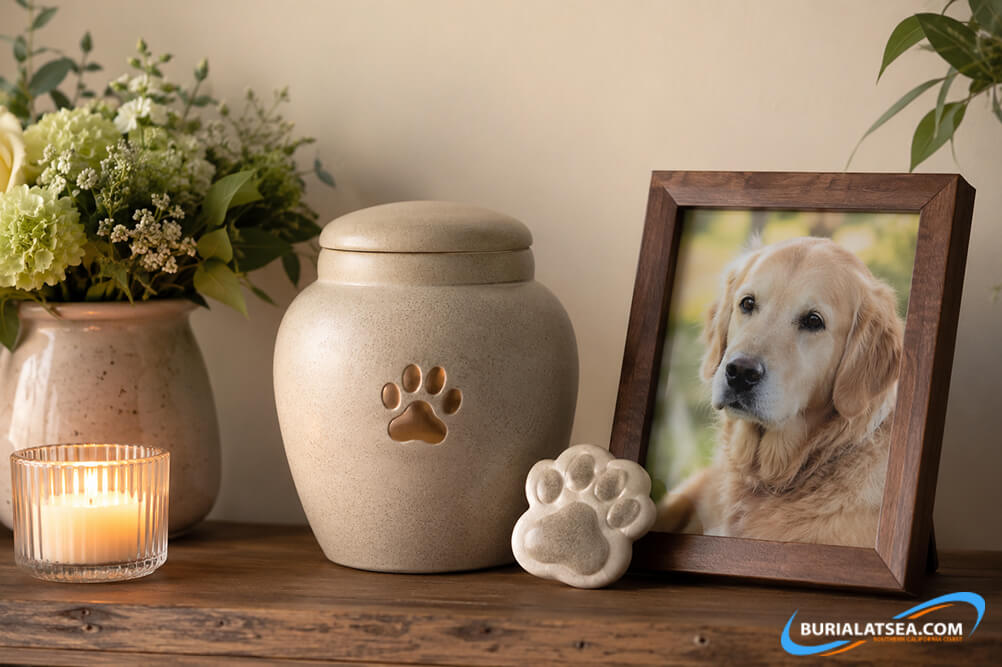
The EPA does not allow pet ashes or other nonhuman remains to be mixed with human cremated remains under the MPRSA general permit.
This restriction applies even when the deceased person specifically requested that their ashes be combined with those of a beloved pet. Once human cremated remains are commingled with animal remains, the combined ashes no longer qualify for burial at sea under the standard federal permit.
Families wishing to preserve a connection between a person and a pet should consider keeping the remains in separate sealed urns and discussing land-based interment options with a cemetery or funeral director.
Legal Alternatives to Scattering Pet Ashes at Sea
Although the standard federal permit does not allow pet ashes to be scattered in the ocean, families still have several respectful ways to memorialize a companion animal.
Pet Cemeteries and Memorial Gardens
Pet cemeteries provide designated spaces for burying pet urns or placing cremated remains in memorial gardens, niches, or columbariums.
These facilities may offer:
- Individual pet burial plots
- Community memorial gardens
- Personalized plaques or markers
- Urn placement
- Memorial trees or landscaped areas
- Private remembrance ceremonies
Burial on Private Property
Some local jurisdictions allow pet remains or pet ashes to be buried on privately owned property. However, zoning rules, property restrictions, environmental regulations, and homeowners’ association requirements may apply.
Before arranging a home burial, families should determine:
- Whether local ordinances permit pet burial
- Whether there are setback requirements from wells or waterways
- Whether the property is rented or owned
- Whether future property transfers could affect the memorial
- Whether the pet was euthanized using a medication that requires special handling
A veterinarian or local animal-control agency may be able to provide region-specific guidance.
A Pet Urn or Keepsake Memorial
Keeping a pet’s cremated remains at home can provide comfort while allowing the family more time to choose a permanent memorial.
Options include:
- Traditional pet urns
- Engraved wooden memorial boxes
- Photo urns
- Small keepsake urns for multiple family members
- Memorial jewelry containing a symbolic portion of the ashes
- Paw-print displays
- Custom artwork or shadow boxes
Families do not need to make a permanent decision immediately. A sealed urn can be kept safely until an appropriate long-term arrangement is selected.
Cemetery Interment With a Human Family Member
In some states and cemeteries, cremated pet remains may be interred with or near the remains of the pet’s owner. The rules vary considerably by state and by cemetery.
For example, Florida law does not prohibit the interment of a deceased person with the separately inurned cremated remains of that person’s pet, provided the remains are not commingled and proper authorization has been obtained.
Virginia permits cemetery companies to establish clearly marked, separate sections for the interment of deceased humans and their pets. Its law also provides that an uncremated pet cannot be placed in the same grave, crypt, or niche as human remains.
These examples demonstrate why families must verify both state law and the individual cemetery’s policies.
Can You Be Buried With Your Pet’s Ashes?
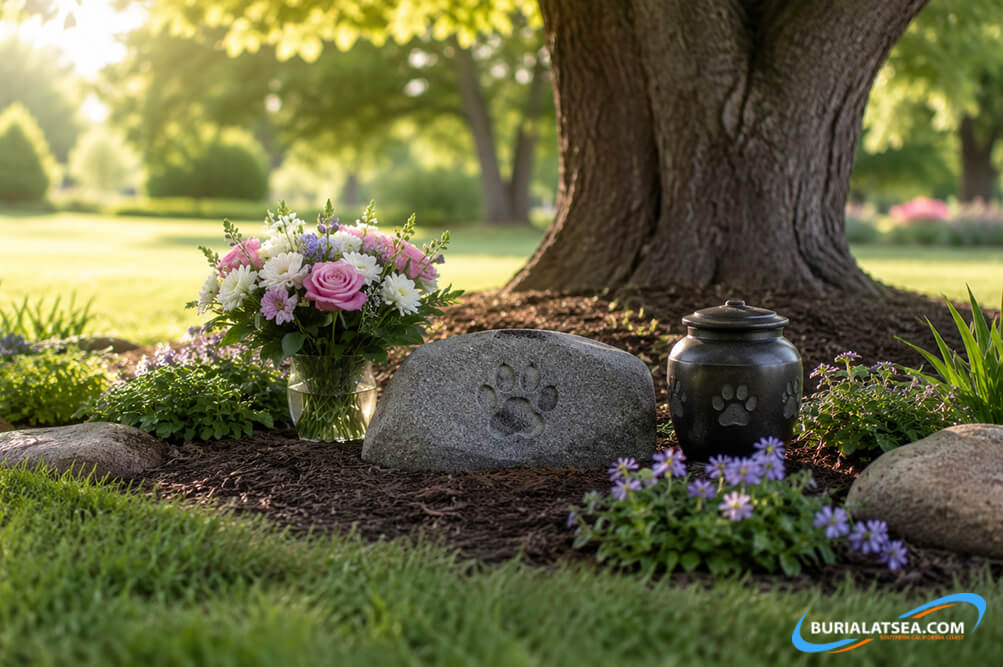
In many situations, it may be possible for a person to be buried with a pet’s ashes, but there is no single nationwide rule that guarantees this option.
The final decision may depend on:
- State cemetery laws
- Local regulations
- The cemetery’s written rules
- Religious cemetery policies
- Funeral-home requirements
- The type and size of the pet urn
- Whether the ashes must remain in a separate container
- Whether the pet urn requires its own burial vault
- The type of burial plot, crypt, or niche being used
Possible arrangements may include placing a sealed pet urn inside a human casket, placing separate human and pet urns in the same plot, or selecting a cemetery with a designated human-and-pet burial section.
Never assume that a pet urn will be treated as an ordinary personal item. Obtain written approval from both the cemetery and the funeral home before relying on this arrangement.
Should Human and Pet Ashes Be Kept Separate?
Keeping human and pet cremated remains in separate, clearly identified containers is generally the most practical approach when future burial arrangements are uncertain.
Separate urns provide several advantages:
- They preserve the identity of each set of remains.
- They make it easier to comply with cemetery rules.
- They allow the family to change memorial plans later.
- They prevent accidental commingling.
- They may provide more options for burial, storage, or memorial placement.
This is particularly important for families considering a future human burial at sea. Human ashes mixed with pet ashes are not authorized under the EPA’s standard burial-at-sea permit.
Legal and Meaningful Alternatives for Memorializing a Pet

Choosing a memorial for a beloved pet is an intensely personal decision. Although scattering pet ashes at sea is not covered by the federal general permit, families still have many compassionate and lawful ways to preserve their pet’s memory.
A pet cemetery, memorial garden, private urn, personalized keepsake, or approved co-burial arrangement can provide a lasting connection without creating legal or environmental concerns.
The most important step is to verify the rules before acting. Regulations differ depending on the type of remains, the location, the state, and the policies of the cemetery or property owner.
Planning Burial at Sea in Southern California
While the federal general permit does not authorize pet ashes at sea, BurialAtSea.com helps families arrange dignified and carefully coordinated ocean memorials for their deceased human loved ones. Our services include attended and unattended ash-scattering ceremonies and full-body burials off the Southern California coast, including departures serving San Pedro, Long Beach, and Catalina Island. Our team can help families understand the planning process, select an appropriate ceremony, and create a respectful final voyage that honors the life and wishes of their loved one.
To learn more about our burial-at-sea services for human remains or to begin planning a meaningful ocean memorial for a loved one, please visit the vebsite or contact our team at 310-714-0548. Our team is committed to helping your family create a respectful and meaningful farewell that reflects your loved one’s life, wishes, and legacy.